Analyzing the etymology of the names of heroes and deities is one of the existing ways to increase our knowledge of the aboriginal mythology of the Antilles. In this work, we examine the cases of four mythical figures mentioned in the An Account of the Antiquities of the Indians, a work by Friar Ramón Pané, a Catalan religious of the Order of the Hieronymites, commissioned by Christopher Columbus to “learn and understand the beliefs and idolatries of the Indians.”¹
The original of An Account, written between 1495 and 1498, was not preserved, and this work has reached the present day through translations and summaries. The way in which the words of the Island Arawak were recorded in these versions were analyzed by Juan José Arrom, who notes: “In those copies, compendiums, and translations, the Taíno words that appear in the An Account have undergone considerable alterations.”2
The names we will analyze on this occasion are: Yahubaba, Yahubabayael, Inriri Cahubabael, and Itiba Cahubaba. They appear only in the Italian translation of the An Account, made in 1571 by Alfonso de Ulloa from the version that Fernando Colón, the Admiral’s son, included in his father’s biography, the latter work remaining unpublished and lost.
The spelling in which we show these names corresponds to the retranslation from Italian to Spanish of Ulloa’s version made by the Cuban scholar, José Juan Arrom. Ulloa records them as Giadruuaua; Giahuba Bagiael; Inriri or Inrire Cahuuaial; Itiba Tahuuaua, respectively3. In our analysis, we will start from Arrom’s version.
The passages mentioning the first three characters are part of the narrative of the hero Guahayona’s exploits, an allegory of the Neolithic Revolution, characterized by the transition from an aboriginal society composed of relatively isolated groups of hunter-gatherers to a tribal organization. In particular, the narrative symbolically emphasizes the prohibition of incest and the emergence of the chieftain figure. It spans Chapters I through IX of An Account.
A brief summary of Guahayona’s story can be outlined as follows: the ancestors of the indigenous people lived in two caves named Cacibajagua and Amayaúna, located in the Cauta mountains in the province of Caonao. One of them, named Guahayona, sends Yahubaba to find the herb called digo to wash and purify themselves. After Yahubaba’s failure and his transformation into the bird Yahubabayael, Guahayona left with all the women in search of other lands, leaving behind the children and the rest of the men. He arrived at the island of Matininó, where he abandoned the women and went to another island called Guanín. There, he underwent a process of purification and transformation that allowed him to receive the cibas and guanines, symbols of the chief’s authority, and to change his name. Later he returns to Cauta, where abandoned children turn into frogs and men get new wives by transforming asexual beings they found in the trees, with the help of the inriri cahubabayael bird.
Yahubaba and Yahubabayael
Let’s look at the excerpt from Chapter II of the An Account where the story of these characters is narrated:
[…] It happened that a man whose name was Guahayona, told another who was called Yahubaba, to go and gather a plant called digo, with which they clean their bodies when they go to bathe. He went out before dawn, and the Sun caught him along the road, and he was turned into a bird that sings in the morning, like the nightingale, and is called Yahubabayael4.
In the word Yahubaba, the morphemes yahu and (a)baba are distinguished. The former has a cognate in Lokono, an Arawak language of the Guianas region, related to the Insular Arawak spoken by the aborigines of the Greater Antilles and the Bahamas. C. H. de Goeje, in his book, The Arawak Language of Guiana, states: “ü-ya: 1st. that by which plants, animals, and men are differentiated from dead matter, 2nd. something ethereal (shadow, image, aroma, etc.)”5. Later, he reproduces the different forms in which various authors have recorded this word and its meanings: üeja, úeja-hu, üya, üyá, üyá-hu, ‘spirit’, ‘shadow’, ‘image’6. We consider that in the word analyzed, the meaning of yahu is ‘image’.
As for the second morpheme, it also has an identical cognate in Lokono: ababa, ‘another’, ‘different’, according to John Peter Bennett, a native speaker of Lokono7.
Thus: yahu, ‘image’ + (a)baba, ‘other’, ‘different’ = Yahubaba, ‘another image’, ‘transformation’. This name corresponds to the metamorphosis that Yahubaba underwent when he was surprised by the sun on the road and turned into a bird.
In the case of the word Yahubabayael, its structure shows the segments yahubaba + ya + el = Yahubabayael. The first is already known, ‘transformation’; the second corresponds to the cognate lokono ü-ya, ‘spirit’, and as for the suffix –el, Pané says that it means ‘son of’8. It is the masculine variant of the suffix –ey, which in other works we have found can also mean, ‘of the lineage of’, ‘of the class of’9, and it can even mean, ‘manifestation of’.
So, yahubaba, ‘transformation’ + ya, ‘spirit’ + -el, ‘son of’, ‘manifestation of’ = yahubabayael, ‘son of the spirit of transformation’, ‘manifestation of the spirit of transformation’.
Pané not only says that Yahubaba turned into a bird, he specifies that it is the “bird that sings in the morning, like the nightingale.” In the Antilles, such a bird is the mockingbird, Mimus polyglottos (see Figure 1), which sings most frequently at dawn when the sun is above the horizon10 and rivals the European nightingale in the beauty and complexity of its song. Everything seems to indicate that the indigenous people linked the morning song of this bird with the moment when Yahubaba was surprised by the sunrise and transformed into a bird.
That’s not the only characteristic Yahubaba and the mockingbird share. This bird possesses the incredible ability to mimic the calls of other birds, animal sounds, and even various other noises. Given the central role of transformations in the myths recounted by Pané, it’s safe to say that the indigenous people believed the mockingbird could truly transform into other birds or beings. Hence the connection with Yahubaba and the origin of its name.
The power of transformation in the mythology of the indigenous people of the ceramic culture of Antilles is a property of the spirits or cemís and their descendants. Yahubaba is a cemí, and the Yahubabayael bird (the mockingbird), another form of its manifestation, with the same supernatural powers. In 1798, a lignum vitae wood icon of a cemí, which represents a bird-man, was found in a cave in Jamaica (Figure 2). To date, this icon has not been linked to any specific mythological figure. In our opinion, it is a representation of Yahubaba’s transformation process, which occurs from the head, first touched by the rays of the rising sun, down to the feet. The head is now practically that of a bird, although it retains the headdress that indicates its status. In the beak, externally fully formed, human teeth remain, represented by pieces of shell. The figure’s torso still has arms, but with feathers where the hands used to be, and they extend to the sides in the typical wing-flashing position that mockingbirds frequently adopt when on the ground (Figure 1b). The human genitalia are visible, indicating the male sex, and the legs begin to merge to form the bird’s tail.
The work, found in Jamaica and created between the years 1029 and 1156 11, shows great fidelity to the myth collected by Pané in Hispaniola at the end of the 15th century, which proves the unity and antiquity of the religion of the aborigines of the Greater Antilles.
Figure 1
Mockingbird(Mimus polyglottos)
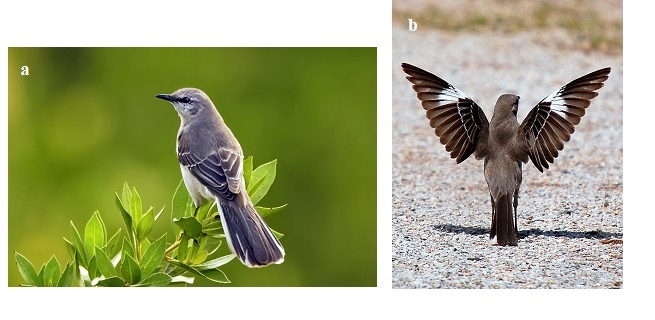
b. Photo: Manjith Kainickara. CCASA 2.0
Figure 2
Wooden carving of a bird-man spirit
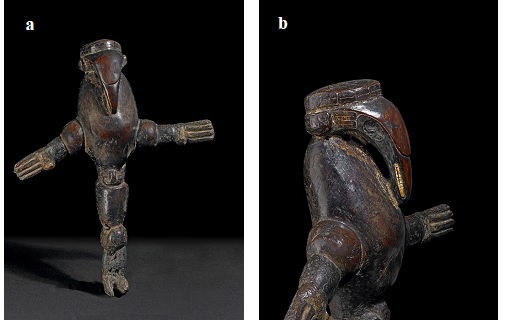
b. Photo: The British Museum CC BY-NC-SA 4.0
Inriri Cahubabayael
In Chapter VIII of An Account, this mythical figure is mentioned:
They looked for a bird called inriri, formerly called inriri cahubabayael, which makes holes in the trees, and in our language is called a woodpecker. And likewise they took those women without the sex of male or female, and they tied their hands and feet, and they brought the aforementioned bird and tied it to their bodies. And believing they were trees, the bird began his customary work, picking and burrowing holes in the place where the sex of women is generally located. And in this way the Indians say that they had women, according to the stories of the most elderly12.
Since we know that Inriri Cahubabayael is the woodpecker, we can assume that it is the Melanerpes striatus, the most common species of this bird on the island of Hispaniola. The similarity of this bird species’ features to those of an iconic representation of Inriri (see Figure 2) confirms this identity. The more prominent head of the sculpted figure appears to correspond to a bonnet or headdress, the presence of which is common in cemi icons to indicate their high rank.
Figura 3
Melanerpes striatus and icon of Inriri Cahubabayael
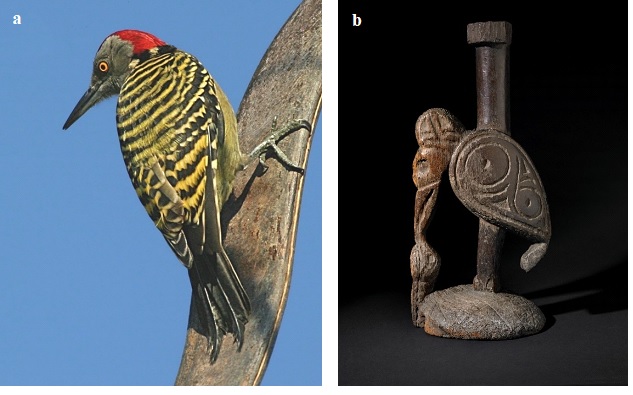
b. Photo: The British Museum CC BY-NC-SA 4.0
In the word Inriri, the morphemes In-iri-(i)ri are distinguished. For the analysis of the morpheme iri, we will use the sound symbolism in Lokono, according to the study carried out by C. H. de Goeje, since we consider it to be the same as that of Island Arawak. The intrinsic meaning of i implies that time remains unchanged, contracted into a single point, into the infinitely small, and is sometimes translated as ‘here’13. For its part, r indicates the principle of “fixed”, “incapable of movement” or “movement impeded”14. Therefore, in the morpheme iri, the initial i indicates a starting point and the final i a final point, with the intermediate r indicating the fixed state of the entire segment.
We can find this symbolism in several words; for example, airi ~ ari, ‘tooth’; a word that exists with the same meaning in both Lokono and Island Arawak15; iri also means ‘name’ in Lokono16, where the initial i symbolizes the initial moment of existence and the second i, the end. The r expresses the meaning of ‘fixed’, since the name accompanies the person, animal, or object named throughout its existence. The word iri also means ‘intergluteal cleft’ in Lokono17. Finally, the Lokono word isiri is formed by is(i), ‘head’ + iri = isiri, ‘nose’, ‘beak’18. In short, the morpheme iri describes the beak of the woodpecker.
The French linguist, Marie France Patte, points out that in Lokono reduplication is used to indicate ‘repetition’ or ‘duration’. Likewise, to express ‘propensity’, ‘inclination’. For example, durhudurhu, ‘crocodile’, from durhudun, ‘to drag’, describes the repetitive movements of this animal when moving19.
We now see that the reduplication of the morpheme iri in the word in(i)riri indicates the repetitive movement of the bird’s beak. In Lokono, the names of other birds also feature the iriri segment in their structure, for reasons similar to those explained (though not exactly the same). For example, haubariria, ‘harpy eagle’20; bariri, ‘falcon’, ‘vulture’21.
The morpheme in in the initial part of the structure of inriri, is described for the lokono by C. H. de Goeje as a suffix with the meaning of ‘being continuously present’22. In the Island Arawak name of the woodpecker, it reinforces the idea of the constant repetitive movement of the beak, which is a unique characteristic of this bird, and distinguishes it from eagles, hawks and vultures.
The fact that the morpheme in appears as a prefix and not as a suffix in the Island Arawak word seems to be a difference between this language and Lokono.
Thus, in, ‘continuously present’, ‘constant’ + (i)riri, ‘pecking’ = inriri, ‘constant pecking’.
Let us now turn to the second part of the Island Arawak name for the woodpecker, Cahubabayael. In our opinion, the original word must have been Yahubabayael, just as in the case of the bird into which Yahubaba was transformed. Its meaning is the same, ‘son of the spirit of transformation’, ‘manifestation of the spirit of transformation’. It is another incarnation of the same cemí, hence its ability to transform asexual beings into women. The existence of several identical or similar names in the An Account of the Antiquities of the Indians could have led to the error on the part of the author himself or on the part of Ulloa.
In the Inriri Yahubayael icon shown in figure 3b, the bird-cemí pecks a turtle in the mouth. The scene depicted relates to another mythical event recounted by Pané, which is part of the narrative concerning the creation of the world, the seas and the fish; the appearance of humankind; the mastery of fire; and the beginning of agriculture. It encompasses chapters IX through XI of the An Account.
The following is a brief summary of this narrative, first according to Pané’s version and then with the aspects of Peter Martyr d’Anghiera version that differ from the former:
Yaya kills her rebellious son Yayael and hangs a gourd containing his bones from the ceiling of her house. Four twin sons of Itiba Cahubaba arrive in Yaya’s absence and take down the gourd, which falls and breaks; from it flow water and fish that form the sea. The four twins arrive at the house of the old man Bayamanaco, and the eldest, Deminán Caracaracol, asks him for cassava bread, but the offended old man throws a gourd full of cohoba fruit at his back. A tumor appears on Deminán’s back, from which a turtle emerges when it is cut open. The brothers build a house and raise the turtle23.
In the version of Peter Martyr d’Anghiera, Bayamanaco spits on Deminán Caracaracol’s back. The blow causes a tumor from which a woman is born when it is cut open. The brothers father sons and daughters with her24.
José Juan Arrom, in his important 1975 work, Mitología y artes prehispánicas de las Antillas, observed that what actually emerged from Deminan’s back was a turtle. He was able to verify this by identifying an icon representing this mythical figure, on whose back a turtle is clearly visible (Figure 4). His interpretation was that the brothers procreated with the animal, as occurs in other Greek and Indigenous American myths, and he attributed Peter Martyr d’Anghiera’s version of the birth of a woman to an “intuitive translation,” in which he adapts the indigenous narrative to Christian beliefs and identifies the woman with the biblical Eve25.
However, by linking the results of the etymology of the name Inriri Yahubabayael with aspects of the indigenous mythology of the Antilles and South America, it becomes clear that Peter Martyr d’Anghiera’s version might not actually be so far off the mark. The Puerto Rican researcher, José Oliver, has pointed out:
In several mainland myths, particularly in the Guianas, the animal theme of the “long-beaked bird” (of various species) is the figure to whom the first men turn when women, properly speaking, did not yet exist, with all their human attributes. […] Among some South American cultures, particularly among the Yekuana Caribs of Guyana, who call themselves So’to (true people), proto-women are presented as incomplete beings, insufficient in their biological reproductive potential, and/or as aggressive, seductive, and dangerous women whose behavior precludes the possibility of a socially productive relationship: the impossibility of coitus between men and proto-women resulting in viable offspring in the social world. Myths regularly resolve this dilemma through a series of transformations of this proto-feminine figure. Heroes/deities whose characteristics are associated with celestial bodies and/or animals usually mediate these changes26.
Analyzing the icon in Figure 3b from this perspective, Oliver points out that this magical bird plays the main (and mediating) role in the acquisition of women by Man and concludes:
How can we explain that the penis-beaked bird of the Jamaican figurine penetrates the mouth and not the vulva of the turtle-woman? In both cases, we see that the common point of penetration is an orifice or opening. In the purification rite with vomica spatulas, it is the mouth that is the point of penetration, while in the myth of the proto-wooden women, it is the vulva. Therefore, the following relationship can be established: Just as the bird’s beak opens the digestive system for the purification of the human body and allows communication with the sacred, the bird’s beak also opens the sexual apparatus to allow access to the remote woman. This is how the primordial (sacred) woman can be receptive to human beings27.
Although Oliver does not categorically state that the turtle undergoes a complete transformation into a woman, we consider such an outcome probable, since, as we have already pointed out, the transformation of outward appearance between humans and animals is a recurring theme in the aboriginal mythology of the Antilles. But even if the transformation is not external and is limited to turning the turtle into a being capable of bearing human offspring, the function of Inriri Yahubabayael remains the same: he is the bearer of the numinous power that makes the change possible. The scene we observe in the icon of Figure 3b is most likely the very moment when the “spirit of transformation” transforms the turtle into the mother of humankind.
Figure 4
Deminán Caracaracol and the turtle on his back
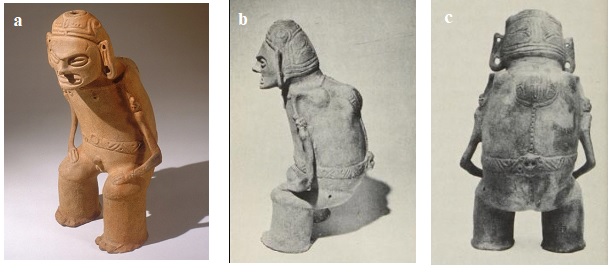
b. Photo: Arrom. Mitología y artes prehispánicas de las Antillas. Courtesy of the Museum of the American Indian. Heye foundation. New York.
c. Photo: Arrom. Mitología y artes prehispánicas de las Antillas. Courtesy of the Museum of the American Indian. Heye foundation. New York.
Itiba Cahubaba
Let us look at the fragment from Pané’s work where Itiba Cahubaba is mentioned:
They say, thus, that one day when Yaya had gone to see his conucos, which means possessions, which were his inheritance, four men arrived who were the sons of one woman, who was called Itiba Cahubaba, all from one womb and identical. When that woman died in the childbirth, they opened her up and took out the four said sons28.
In the structure of the word itiba, the morphemes iti + ba = itiba can be seen. In his analysis of this word, Arrom considers that the first morpheme corresponds to the lokono word ite ~ üttü ~ üthe, ‘blood’, but we differ from that proposal and consider that it corresponds to the homonymous lokono word, ite, ‘belly’, ‘womb’, ‘bowels’29.
As for the morpheme ba, it corresponds to the word lokono (üi)ba, which has several meanings, including: ‘leave’, ‘depart’, ‘placenta’30, 31.
In such a way, ite, ‘womb’ + (üi)ba, ‘exit’, ‘placenta’ = itiba, ‘exit womb’, ‘placenta womb’ ‘pregnancy’. An analysis like the one we have just done requires confirmation in other ways, given the different meanings that the morphemes involved in principle could have. Fortunately, this is possible. Let us examine the following voices of lokono: t-itibadona, ‘pupa’, ‘chrysalis’32; t-itibo-ko, ‘bird’s nest’33.
In the first word, we distinguish the following structure: t + itiba + dona = t-itibadona. The first t is the abbreviation of t(hi), a personal pronoun that in this case denotes non-human gender of the third person, whether singular or plural34; itiba means ‘pregnancy’, and dona is an abbreviation of donwa35, the latter segment composed of the suffixes -do and -(o)nwa ~ onoa. The first is added to nouns that in this way acquire the general meaning of ‘entity characterized by its location in the place indicated by the root of the word’; For example, konoko, ‘forest’, ‘jungle’, ‘mountain’ and konokodo, ‘Maroon’36 (‘he who is in the mountain’). For its part, – (o)nwa is a reflexive-passive suffix37. Thus, t-itibadona literally means ‘the one who is in his own pregnancy’, ‘pregnant with himself’, a precise description of the biological process that characterizes a chrysalis.
In the second word we see the following structure: t-iti-bo-ko. We know the meaning of the first two morphemes. The suffix –bo is an indicator of an activity in progress38 and in this case it is signaling that the eggs in the “womb” (nest) must go through an incubation stage. Furthermore, when the chicks are born they are not expelled from the nest, which is why the use of the suffix –ba, ‘exit’, is not appropriate. For its part, the suffix –ko is a continuous adverbializer, which indicates that the activity expressed by the verb to which it is attached has not yet concluded39. We also consider that the suffix –ko, in this case, has the “fossilized” meaning, ‘participants equally involved in an activity’ and ‘spatial proximity’, which this suffix does have in Island Arawak, as we demonstrate in a previous job40. Describe here the arrangement of the eggs in the nest.
Thus, the meaning of t-itibo-ko is: ‘those who remain together in the womb’, ‘nest’. The results of the analysis of this word and the preceding one confirm that itiba means ‘pregnancy’.
Let us now examine the word cahubaba. First, we must note that there is no relationship between this word and the toponym Cajobabo, the name of a locality in the Cuban province of Guantánamo, as Arrom suggests in his notes to Pané’s work41. Another common toponym in Cuba, Jobabo, as Arrom himself explains in another of his works, means ‘abundance of jobos’ (Spondia mombin)42, a tree common in the Caribbean. The structure of Cajobabo can be segmented as follows: Ca-jobabo, where the initial prefix corresponds to the cognate lokono ka, a distinctive attributive prefix of the Arawak language family, which means ‘to have’ and in some cases can express ‘to be with’, ‘to be next to’. For example, in lokono, kayoa, ‘to be in the company of one’s mother’ (oyo, ‘mother’)43; kaithe, ‘to be in the company of his children’ (aithi, ‘children’)44. Therefore, Cajobabo, ‘to be in the company of the jobo forest’, ‘to be next to the jobo forest’.
After exhaustive analysis, we believe there is an error in the recording of the name Cahubaba, probably made by Pané himself for reasons we will explain later. In our opinion, the original word in Island Arawak is Caüibaba. Its structure reveals the morphemes ca-üiba-(a)ba. The first is the attributive prefix we examined earlier, meaning ‘to have’; the second, also studied during the analysis of the word itiba, means ‘exit’ or ‘placenta’. Finally, aba has an identical cognate in Lokono, meaning ‘some’ or ‘several’45. Therefore, Caüibaba means ‘with several exits’ or ‘with several placentas’.
The inaccurate recording of the word Caüibaba is due to the presence in its structure of a phoneme that does not exist in the Spanish language and its substitution by Pané with another phoneme known to him. Although it has been pointed out that the phonetic-phonological system of Island Arawak was not as complex as that of other continental American languages, which contributed to facilitating the assimilation of numerous indigenous words, the studies we have carried out indicate that these differences did exist and have been, to some extent, underestimated.
The diphthong üi is found in the structure of the Lokono word üiba. John Peter Bennett, a native speaker of that language, states that the ü is pronounced like ir in the English word fir46. Konrad Rybka, a linguist who published an important study on Lokono in 2015, transcribes this diphthong using the notation of the International Phonetic Alphabet: /ɨi/ and describes its second element (i) as a semivowel y47. We consider that this same pronunciation is present in the analyzed Island Arawak cognate.
Pané’s registration error may also have been influenced by the analogy with the words Yahubaba and Yahubabayael, mentioned earlier in his An Account.
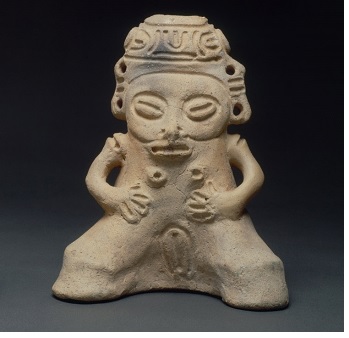
Finally we arrived at the desired meaning: Itiba, ‘pregnancy’ + ‘Caüibaba, ‘with several placentas’, ‘with several exits’ = Itiba Caüibaba, ‘pregnancy of several placentas’, ‘pregnancy of several exits’, ‘multiple pregnancy’.
The icons representing Itiba Caüibaba (Figure 5) are characterized by their emphasis on her disproportionately large belly. She is depicted in the act of childbirth, kneeling, a common position among Indigenous women, which increases the total surface area for delivery and is especially appropriate for the expulsive stage48. Her face shows the characteristic tension of pushing and the concentration on the process, while she pushes with her hands on her belly to aid the delivery of the fetuses. A moan seems to escape from her slightly open mouth. Despite her high rank, symbolized by the headdress covering her head, everything indicates that she faces this difficult situation alone.
Given the well-known ending of the drama depicted, the work undoubtedly makes a strong impression on viewers and fully achieves its artistic purpose. As with other works of art examined in this study, its ability to portray dynamic events is admirable.
In this icon, as in the previous ones presented, there is also a full correspondence with the myths narrated by Pané.
Figure 5
Itiba Caüibaba
References
- Pane, Fray Ramón. 1990. Relación acerca de las antiguedades de los indios con estudio introductorio, notas, mapas y apéndices de José Juan Arrom [An Account of the Antiquities of the Indians. A New Edition, with Introductory Study, Notes, & Appendixes by Jose Juan Arrom]. Editorial de Ciencias Sociales. La Habana. Page 23.
- José Juan Arrom. 2011. “El mundo mítico de los taínos: notas sobre el Ser Supremo” [“The Mythical World of the Taíno: Notes on the Supreme Being”]. In José Juna Arrom y la búsqueda de nuestras raíces. Fundación García Arévalo y Editorial Oriente. Santiago de Cuba. Page105. www.cubaarqueologica.org.
- Pane, Fray Ramón. 1990. op. cit.
- Pane, Fray Ramón. 1999. An Account of the Antiquities of the Indians. A New Edition, with Introductory Study, Notes, & Appendixes by Jose Juan Arrom. Translated by Susan C. Griswold. Duke University Press. Durham and London. Chapter II.
- Goeje. C. H. de. 1928. The Arawak Language of Guiana. Cambridge University Press. Page 203. www.cambridge.org.
- Goeje. C. H. de. 1928. op. cit. Page 204.
- Bennett, John Peter. 1989. Arawak-English Dictionary With an English Word-list. Walter Roth Museum of Anthropology. Georgetown. Page 1.
- Pane, Fray Ramón. 1990. op. cit. Page 30.
- Celeiro Chaple, Mauricio. 2024. Atabeira, los nombre de la diosa [Atabeira, The Names of the Goddess]. www.laotraraiz.cu.
- Hill, Christopher E. et al. 2005. “Does Light Intensity Influence Song Output by Northern Mockingbirds?” En The Chat, Vol. 69, No. 2. Spring 2005. Pages 61-67.
- www.britishmuseum.org/collection/object/E_Am1977-Q-2.
- Pane, Fray Ramón. 1999. op. cit.
- Goeje. C. H. de. 1928. op. cit. Page 49.
- Goeje. C. H. de. 1928. op. cit. Page 135.
- Goeje. C. H. de. 1928. op. cit. Page 140.
- Goeje. C. H. de. 1928. op. cit. Page 140.
- Patte, Marie France. 2011. La langue arawak de Guyane, Présentation historique et dictionnaires arawak-français et français-arawak. IRD Éditions. Marseille. Page 104. https://horizon.documentation.ird.fr.
- Goeje. C. H. de. 1928. op. cit. Page 153.
- Patte, Marie France. 2011. op. cit. Page 23.
- Bennett, John Peter. 1989. op. cit. Page 14.
- Patte, Marie France. 2011. op. cit. Page 55.
- Goeje. C. H. de. 1928. op. cit. Pages 77-78.
- Pane, Fray Ramón. 1990. op. cit. Pages 30-33.
- Pedro Mártir de Anglería. 1892. “Décadas del nuevo mundo” [“Decades of the New World”]. En Fuentes históricas sobre Colón y América.Libros rarísimos que sacó del olvido, traduciéndolos y dándolos a la luz en 1892, el Dr. D. Joaquín Torres Asensio. Page 76. https://archive.org.
- Arrom, José Juan. 1975. Mitología y artes prehispánicas de las Antillas [Mythology and pre-Hispanic Arts of the Antilles]. Siglo veintiuno editores. México. Pages 138-143.
- Óliver, José R. 1998. El centro ceremonial de Caguana, Puerto Rico. Simbolismo iconográfico, cosmovisión y el poderío caciquil Taíno de Boriquén [The ceremonial center of Caguana, Puerto Rico. Iconographic symbolism, worldview, and the Taíno chiefdom power of Boriquén]. BAR International Series 727. Page 145.
- Óliver, José R. 1998. op. cit. Page150.
- Pane, Fray Ramón. 1999. op. cit. Páges 13-14.
- Patte, Marie France. 2011. op. cit. Page 220 (This author transcribes the word as ute, because it represents the phoneme /ɨ/ as a u).
- Bennett, John Peter. 1989. op. cit.
- Patte, Marie France. 2011. op. cit. Page 53.
- Goeje. C. H. de. 1928. op. cit. Page 263.
- Goeje. C. H. de. 1928. op. cit. Page 130.
- Pet. Willem J. A. 2011. A Grammar Sketch and Lexicon of Arawak (Lokono Dian). SIL e-Books. Page 12.
- Goeje. C. H. de. 1928. op. cit. Page 246.
- Rybka, K. A. 2016. The linguistic encoding of landscape in Lokono. LOT. Utrecht. Page 41. https://www.researchgate.net.
- Pet. Willem J. A. 2011. op. cit. Page 120.
- Rybka, K. A. 2016. op. cit. Page 63.
- Rybka, K. A. 2016. op. cit. Pages 89-90.
- Celeiro Chaple, Mauricio. 2024. Aruaquismos insulares con el segmento “cagua” en su estructura [Island Arawak Words with the “Cagua” Segment in its Structure]. www.laotraraiz.cu.
- Pane, Fray Ramón. 1990 op. cit. Pages 67-68.
- Arrom, Jose Juan. 2011. José Juan Arrom y la búsqueda de nuestras raíces [José Juan Arrom and the search for our roots]. Selection, coordination and introduction by Jorge Ulloa Hung. Fundación García Arévalo y Editorial Oriente. Page 96. www.cubaarqueologica.org.
- Patte, Marie France. 2011. op. cit. Page 181.
- Patte, Marie France. 2011. op. cit. Page 42.
- Bennett, John Peter. 1989. op. cit. Page 1.
- Bennett, John Peter. 1989. op. cit.
- Rybka, K. A. 2016. op. cit. Page 8.
- Gupta J. K. y Hofmeyr G. J. 2003. Posición de la mujer durante el período expulsivo del trabajo de parto [Position of the woman during the expulsive stage of labor]. In Library Cochrane plus, 2008. Número 2. Oxford.