The meaning of the name Havana (Habana in Spanish) arouses great interest and has been the subject of speculation for a long time, without a well-founded etymology proposal being achieved so far. The most accepted hypothesis suggests that it derives from the name of the aboriginal cacique (chief), Habaguanex. Another conjecture presumes that it is a variant of sabana (savanna) a word that entered Spanish from the Island Arawak, the language spoken by the aborigines of the Greater Antilles.
Although a relationship between the names of the chief and the province seems highly probable, this link could be due to reasons other than those suggested by the aforementioned hypothesis. If naming chiefdoms after their chiefs had been a common practice among the indigenous people, chroniclers and historians would very likely have recorded it, and we would know of several examples. However, we know of no proven cases of this type in the Greater Antilles, and the instances where the names of the chiefs and their chiefdoms coincide, either wholly or partially, could be due to the opposite: the chiefdoms taking their names from the chiefdoms.
For its part, the hypothesis about the supposed local variant of the word sabana is also hardly credible, given the symbolism of the sounds in the Arawak languages where each phoneme has an associated intrinsic meaning and generally, its change implies a transformation of the meaning of the word1.
In this paper, we present a proposed etymology for Habana and some other associated words that entered Spanish from the Island’s Arawak language. To this end, we begin with a historical overview of the aboriginal societies in the territory of Havana up to the Spanish conquest, based on the book by Alexis Rives, Juan Pose, and Alex Rives, De los cacicazgos a San Cristobal de La Habana. Crítica a la leyenda negra del exterminio indígena en Cuba [From the Chiefdoms to San Cristóbal de La Habana: A Critique of the “Black Legend” Regarding the Extermination of Indigenous People in Cuba], which compiles the results of archaeological work carried out over many years in the western provinces of Cuba2.
Groups of proto-farmers occupied the territory of the former province of Habana (comprising the present-day provinces of Mayabeque, La Habana, and Artemisa) around 3,000 years ago. Around 1300 CE, agro-potter communities arrived from the east and reached the northeastern area of the province, specifically the localities of Jibacoa and Jaruco, where their westward expansion ceased.
Around 1450, the westward migration of the agro-potter communities resumed, occupying the territory from coast to coast of the province (Figure 1). This movement concluded towards the end of the 15th century. During the interaction between proto-farmers and agro-potter communities, a phenomenon of cultural overlap occurred, with the former being progressively assimilated by the latter, eventually forming a hierarchical structure: the cacicazgos (chiefdoms) encountered by the Spanish upon their arrival.
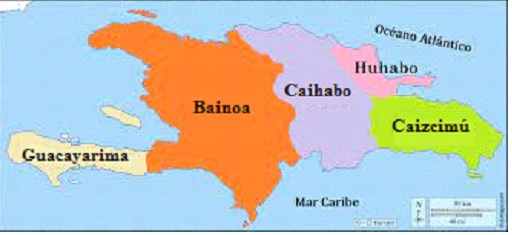
The results obtained by Rives et al. demonstrate that for approximately 150 years, east of Havana, a boundary existed between the agro-potter and proto-farmer communities (Figure 1). Our research, for its part, shows that this prolonged situation left traces in the toponymy of the area, such as in the aboriginal name of the town of Bainoa, in the municipality of Jaruco. This toponym also names an aboriginal province of Hispaniola (Figure 2), which facilitates its etymological analysis.
Figure 1
Ceramic sites in western Cuba up to 1996 and possible boundary between agro-potter and proto-farmers communities between approximately 1300 and 1450.
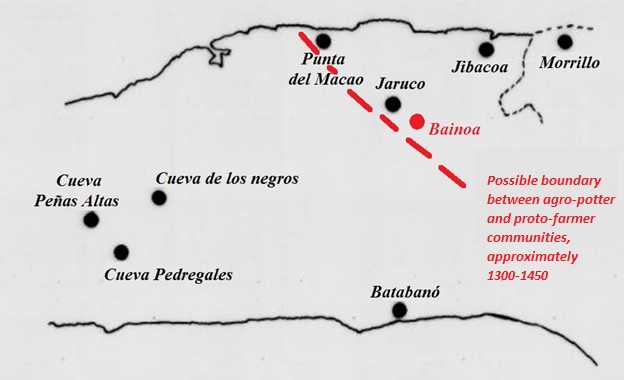
Figure 2
Aboriginal names of the pre-Columbian provinces of Hispaniola, according to the “Decades of the New World” by Peter Martyr d’Anghiera.
In the structure of the word Bainoa, the morphemes ba + in(a) + oa = bainoa are distinguished. All three coincide with identical cognates of Lokono, an Indo-American language of the same family and close to Island Arawak: ba has two functions: it indicates a physical or psychological movement away from the point of reference of the speaker3, and it also means ‘again’, ‘also’4. The morpheme ina means ‘end’, ‘back’5, and finally oa is a reflexive suffix6. Thus, ba, ‘towards there’, ‘again’ + ina, ‘end’, ‘extreme’ + oa, reflexive = bainoa, ‘ends there’, ‘another extreme’, ‘final extreme’.
The word Caicimú, name of the easternmost aboriginal province of Hispaniola (Figure 2), is composed of the morphemes cai + cimú = caicimú. The chronicler of the Indies, Pedro Mártir de Anglería, in his Decades of the New World, had already observed “The beginning of the island to the East is reached by the province called Caicimú, so named because in their language cimú means ‘front or beginning’”7. The Cuban scholar, José Juan Arrom, refers to: Cay-cimú, ‘front of the island’ [cay(o), ‘island’] and points out that the name is related to the trajectory of the aboriginal people in their migratory movement, since they arrived through that place8.
Thus, in the aboriginal toponymy of Hispaniola, the names of two provinces correspond to the beginning and end of the island, that is, its extremes from the point of view of migratory movement. Peter Martyr d’Anghiera mistakenly writes that the aboriginal people considered Guacayarima to be the final province: “…and they call it Guacayarima because it is the extreme part of the island: they call the anus marima: they call it “the ass end of the island”9. In reality, Guacayarima means ‘side of the gulf’ (guaca, ‘gulf’ + yarima, ‘side’, ‘side’), as we demonstrate in the work Guacayarima: the name in its labyrinth, published in The Other Root10.
We can now see that the locality of Bainoa, northeast of Havana, marked the boundary of the territory occupied by the agro-potter communities in the direction of their east-west movement on the island of Cuba (Figure 1).
Let us now turn to the analysis of the name of the cacique Habaguanex. Its structure includes the morphemes haba + guan(a) + –ex. We know the meaning of the last two morphemes from having examined them in other works published in The Other Root. Guana means ‘land’, ‘place’11 and –ex is a variant of the suffix el which, according to Friar Román Pané, who lived with the aborigines and knew something of their language, means ‘son’12.
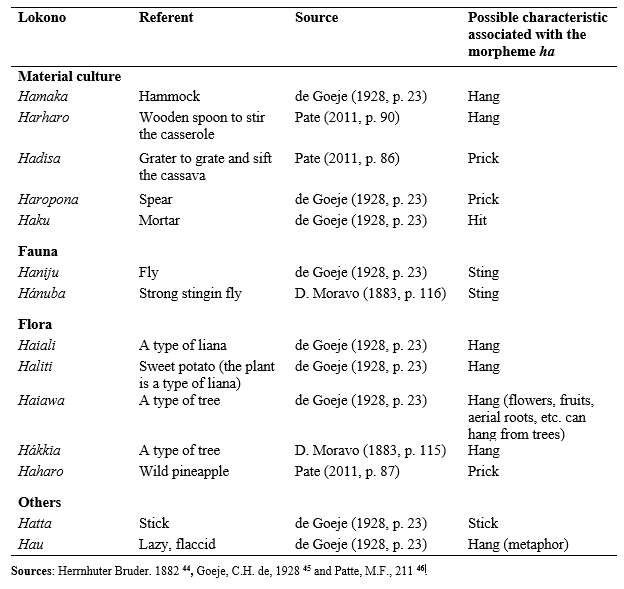
The word haba requires detailed examination. It is composed of the morphemes ha and ba. In the analysis of a sample of 18 words from Island Arawak and 15 words from the Lokono language containing the root ha in their structure, it was found that the following characteristics are repeated in the referents: ‘to hang’, ‘to peck’, ‘to prick’, ‘to nail’, and ‘to hit’. All these actions share a common feature: they are generated by entities that have two ends, one fixed (starting point) and the other free (ending point). It can also denote movement or displacement in a specific direction (see Tables 1 and 2 in the appendix).
Previously we examined the case of the morpheme ba, which indicates a physical or psychological movement away from the point of reference of the speaker, and also means ‘again’, ‘too’.
Then haba denotes the repetitive succession of events in space or time (ha, ‘displacement in a certain direction’; ba, ‘also’, ‘again’). In Lokono, there is the non-identical cognate abá, which, according to John Peter Bennett, a native speaker of that language, means ‘some’, ‘a few’, ‘several’, ‘an unspecified number or quantity’13. In Island Arawak, haba has the same meaning, as will be shown below.
Let’s look at some place names from the Island Arawak language where haba means ‘some’, ‘several’:
Habacoa was the aboriginal name for the island of Andros in the Bahamas, and for one of the regions of Guacayarima, the aboriginal province of Hispaniola. The word’s structure includes the morphemes haba and coa. The latter has a cognate lokono (koa), which Marie France Patte classifies as a “continuative”14 and K. A. Rybka defines as a “continuative adverbializer” when used as a suffix15. The semantic feature of ‘continuation’ is present in one form or another in all its meanings (‘still’, ‘even’, ‘to last’, ‘to remain’, among others). In a previous work, we demonstrated that in Island Arawak, unlike lokono, coa also denotes reciprocal spatial relationships and can sometimes be translated as ‘to remain next to’ or ‘in front of’16.
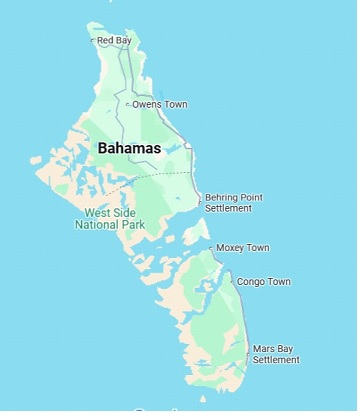
Andros is actually an archipelago made up of several islands, the three main ones of which are separated by inlets or estuaries that divide the island from east to west, forming a repetitive pattern of islands facing each other (Figure 3). This characteristic is what motivates its aboriginal name: habacoa, ‘several, facing each other’, in reference to the islands.
Figure 3
Habacoa Island (Andros) in the Bahamas
According to Peter Martyr d’Anghiera, Habacoa was also one of the thirteen regions of the indigenous province of Guacayarima, on the island of Hispaniola17. If we observe the elongated and narrow shape of that province (Figure 2), we realize that these regions, in all likelihood, must have been opposite one another, a characteristic related in some way to the toponym analyzed. Likewise, Martyr d’Anghiera mentions that Jabaque, an islet in the northern part of Guacayarima, was one of “many small islands, which they believe were once joined together” and adds, “in some places one can wade across the sea between those islands”18, which suggests that the multiplicity and proximity of the islands is related to the name Jabaque.
The word haba ~ jaba has a second meaning in Island Arawak and Lokono. Esteban Pichardo describes the jaba as “a kind of sack made and woven from guano [leaves of a type of palm] to store and transport anything” and adds that they are made of “coarse fabric and wide strips of guano, or fine, smooth of the natural color, single or interspersed with black, in strips or in a mosaic way”19. [Emphasis ours].
It is precisely the alternating and repetitive change in the arrangement of the guano fibers in the weaving of the jaba, forming a pattern or weave, that is the characteristic that motivates the aboriginal name of the utensil (Figure 4).
Figure 4
Jaba made of guano
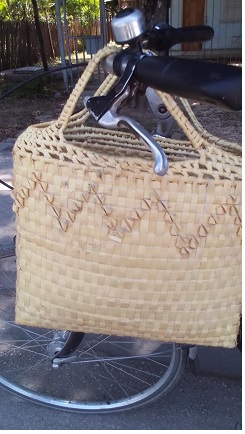
Photo: Idalmis Benítez.
This example demonstrates that the Island Arawak morpheme haba also means ‘repetitive pattern’ or ‘weave’. This conclusion is confirmed by the existence of Lokono words where the morpheme haba with this meaning is found in their structure. In that language, haba is the name of the same utensil designated by the Island Arawak word jaba20 and the word aba also means ‘to make strips of basket material with the fingernails’, as indicated by John Peter Bennett (to strip, to make strips of basket material with the fingernail for use in basketry)21. Likewise, a species of large cockroach found in forests is called hababaro22. The structure of this word is composed of the morphemes haba + (a)baro = hababaro, where abaro denotes ‘a’ or ‘one’ (of feminine or non-human gender)23. Thus, hababaro literally means ‘one of the weave’, ‘one of the thicket’, probably alluding to the fact that the insect hides among the intertwined branches and leaves of the trees that have fallen on the forest floor.
In the Island Carib, an Arawak language with influence from the Continental Carib, spoken by the aborigines of the Lesser Antilles, the fish Atlantic Bonito” (Sarda, Sarda) was called hába, according to the 17th century French missionary, Raymond Breton, in his Dictionnaire caraïbe francais24. This fish has diagonal and vertical lines on its skin that frequently form a characteristic pattern (Figure 5), which motivates its name in that language.
Figura 5
Atlantic Bonito (Sarda, Sarda)
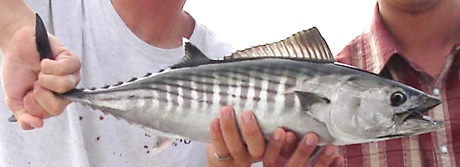
Photo: Susane Heyer from Wikipedia. CCSA 2.5
In Cuban popular speech, there is another archaic word with the morpheme haba in its structure: habato ~ jabato. Pichardo includes it in both forms and, in the first edition of his Provincial Dictionary, indicates that it means ‘a rough, rustic, or uncivil person.’ In the other three editions, he replaces the adjective “uncivil” with “rude.” Furthermore, he considers this word a derivative of the Castilian term haba, ‘a herbaceous plant of the legume family’ and ‘its edible fruit and seed,’ and formulates the hypothesis that it is a “metaphorical reference to the lump that appears in the mouth of animals, from which comes the familiar phrase soltar la haba [to spill the beans], to become civilized, to abandon rude or rustic ways”25, 26, 27, 28.
We hold a different opinion regarding the etymology of this word: habato ~ jabato is an exclusive Cubanism and is only found in some dictionaries dedicated to the Spanish spoken in Cuba. This circumstance, along with its structural composition, demonstrates that it is a word originating from Island Arawak. It is composed of the morphemes haba + -to = habato. The suffix –to / –tu is used in Lokono (and also in Island Arawak) to form substantivized adjectives and attributive adjectives when referring to a woman, one or more non-rational beings or things29, or men who do not belong to one’s own tribe30. Let’s look at some examples from Lokono31, 32:
- ipirun, ‘to be big’; ipirutu, ‘something big’ [‘the big one’].
- wádin, ‘to be long’; wáditu, ‘something long’, [‘the long one’].
- ikihi, ‘fire’; ikihi-tu kaspara, ‘burning sword’.
- sa, ‘good’, ‘holy’; sa-tu ajia-hu, ‘holy word’, ‘the gospel’.
Among the Spanish words originating from the Island Arawak language, in whose structure this suffix is seen, are: boniato (type of edible tuber), ciguato (fish and crustaceans with a disease that affects the people who consume them), caimito (type of tree and its fruit), areíto (ceremony with song and dance of the aborigines), Cauto (name of a river in the eastern region of Cuba).
Thus, haba, ‘weave’, ‘thicket’ + -to, ‘suffix forming substantivized adjectives’ = habato, ‘the one of the weave’ or ‘the one of the thicket’. Proto-farmers lived predominantly in coastal mangrove forests, which are distinguished by their density and the intricate network of roots and branches that hinder movement and facilitate concealment (Figure 6). It is very likely that it was common practice for the shy proto-farmers to hide in their mangrove habitat from the agro-potters. These circumstances may have led to habato also meaning ‘timid’ or ‘uncivilized’. Furthermore, probably due to the less developed state of the proto-farmers, the word also acquired the meanings of ‘rustic’ and ‘rude’.
Figure 6
Mangrove forest
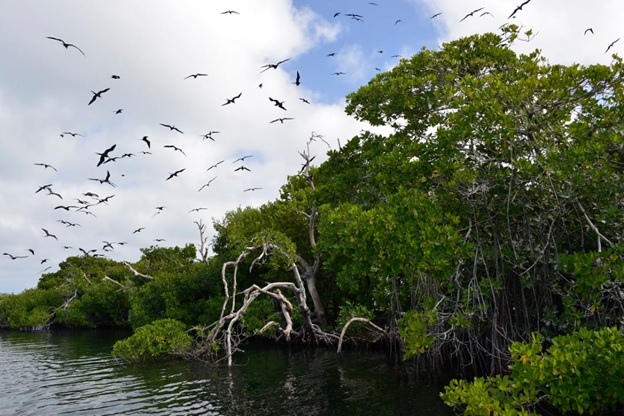
Photo: Noel López Fernández / Naturaleza Secreta. Taken from Cubahora.
In Lokono, there is the word haburi ~ habori, meaning ‘to be ashamed’ or ‘timid’33, in whose structure we find the morphemes hab(a) + uri ~ ori = haburi. The second has two meanings, ‘snake’ and ‘darkness’34, so the literal meaning of haburi would be: ‘snake of the thicket’ or also ‘darkness of the thicket’. In both cases, they relate to the image of someone trying to hide their presence. This supports the previous analysis regarding the origin and meanings of habato.
The archaic and no longer used word habato ~ jabato bequeathed its meanings in Cuban Spanish to the word montuno, which during the 19th century denoted only ‘peasant’ or ‘person who lives in the countryside,’ as Pichardo records in the four versions of his Diccionario provincial, and which currently also indicates: ‘person who behaves in a rustic and uncouth manner’35 and ‘a reclusive person who avoids people’36. If we consider that montuno comes from monte, ‘forest or place populated with wild trees and shrubs,’ the parallels with habato become evident and exhaustive. The word guajiro (peasant) underwent a similar evolution with the incorporation of the meanings of the now obsolete word habato ~ jabato.
The previous results obtained allow us to establish the meaning of the name of the Havana cacique: haba, ‘rusticity’ ‘thickness’ + guana, ‘land’ + -ex, ‘son’, ‘of the lineage’ = habaguanex, ‘son of the rustic land’, ‘son of the montuno land’.
Thus, we arrive at the fundamental question of this work: What does Habana mean? The word’s structure is composed of the morphemes haba + -na = habana. The second is a suffix that has an identical cognate in Lokono, with the meaning of ‘continuation’37, which is used when an event is expected from the general context38. It also denotes ‘expected location’ in phrases to indicate location39.
The study of the use of the suffix –na in the aboriginal toponymy of the Antilles suggests that it was used in the structure of the names of adjacent regions or territories. For example, this can be seen in the names of two cacicazgos (chiefdoms) that existed on Hispaniola at the time of the Spanish arrival: Maguá and Maguana (see Figure 7).
Figure 7
Cacicazgos (chiefdoms) of Hispaniola
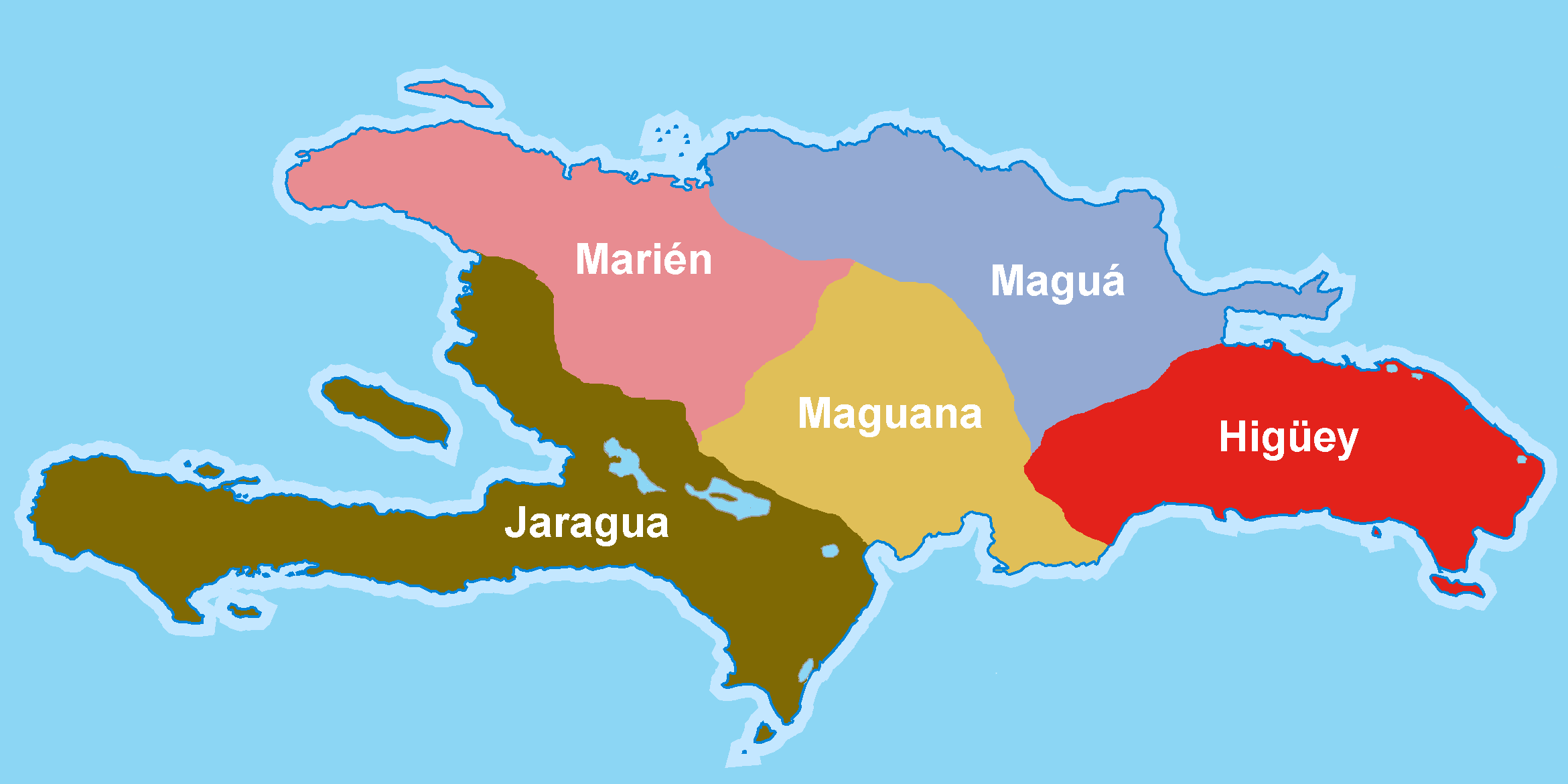
Thus, haba, ‘rustic’, ‘montuno’ + –na, ‘continuation’, ‘neighborhood’ = habana, ‘continuation of the Rustic’, ‘continuation of the Montuno’ or also, ‘neighborhood of the Rustic’, ‘neighborhood of the Montuno’.
As can be seen, there is a close relationship between the names Bainoa, meaning ‘final extreme’ (of the agro-potter communities), and Habana, meaning ‘neighborhood of the Rustic’ or ‘neighborhood of the Montuno’ (of the proto-farmers). The very special circumstances that motivated the name Habana also explain why this aboriginal toponym is not found anywhere else in the Greater Antilles.
From today’s perspective, it is ironic that the land destined to become the capital of Cuba and its most developed region was once known as a place of “rustic” or “montuno” people. In any case, both groups, proto-farmers and agro-potters, eventually merged into a single chiefdom, where the former were treated without distinction, as attested by Bartolomé de las Casas, an eyewitness to the Spanish conquest of Cuba:
Most simple, most good people, devoid of all vices, and most blessed, if only they had true knowledge of God. These were the natural and native people of that island [Cuba], and in their language they called themselves Ciboneyes, the penultimate long syllable; and those from this (Hispaniola), by choice or by force, seized that island and its people and kept them as their servants, not as slaves, because never in all these Indies was it found that they made a distinction, or very little, between free people and slaves and their children, in terms of treatment…40
The adjective “servants” that Las Casas uses, taken from the feudal relations that existed in Spain, does not fully adjust to the nature of the alliances and relations of subordination in an aboriginal cacicazgo (chiefdom), especially those in Cuba that did not have the degree of centralization that existed in Hispaniola. Furthermore, these relationships were the same for all the groups that made up the chiefdom, as the chronicler himself refers. Another mistake by Las Casas is to consider the agro-potters of Cuba as recently arrived from Hispaniola. In reality, there is evidence of their arrival since the 9th century AD, according to the dating of archaeological sites41.
The results achieved in this work are proof of the unity of the history of Cuba and show how events that occurred in a remote past, and until now little known, leave traces in the present. The aboriginal society, violently destroyed by the European conquest, transmitted its heritage to a new people arising from the biological and cultural mixing of aborigines, Spaniards and Africans. The sap that flows from each of the three roots unites into a single torrent that feeds the powerful common trunk that sustains nationality and culture and defies the storms of the modern age.
Appendix
Table 1
Selection of Island Arawak words with the morpheme ha (ja) in their structure, their referents, sources, and possible associated characteristics.
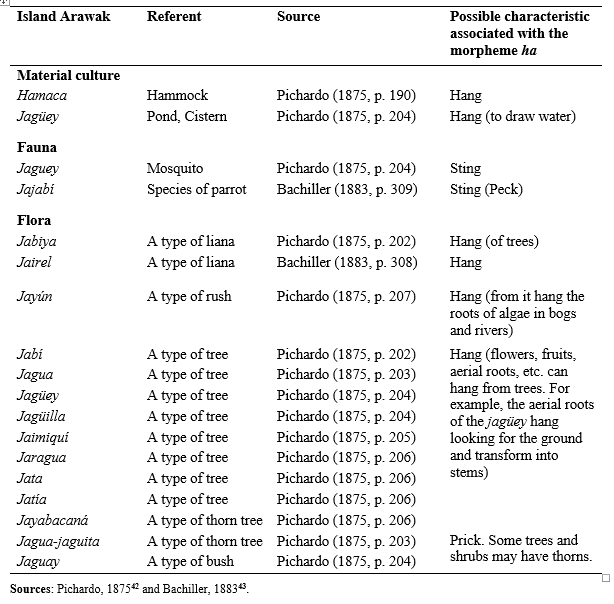
Table 2
Selection of Lokono words with the morpheme ha in their structure, their referents, sources, and possible associated characteristics.
Notes and references:
- This is the case with /s/ and /h/. According to C. H. de Goeje, the former is used to indicate “showing form,” “having a surface of its own, a scale or cuticle,” while the latter is used to indicate “a gentle affirmation” and also “to exhale.” Goeje, C. H. de. 1928. The Arawak Language of Guiana. Cambridge University Press. Pages 148, 152. www.cambridge.org/9781108007689
- Rives Pantoja, Alexis; Pose Quincosa, Juan; Rives Cecin, Alex. 2015. De los Cacicazgos a San Cristobal de La Habana: crítica a la leyenda negra del exterminio indígena en Cuba. [From the Chiefdoms to San Cristobal de La Habana: a critique of the black legend of indigenous extermination in Cuba] Aspha Ediciones. Ciudad Autónoma de Buenos Aires.
- Pet, Willem J. A. 2011. A Grammar Sketch and Lexicon of Arawak (Lokono Dian). SIL e-Books. Page 36.
- Goeje. C. H. de. 1928. op. cit. Pages 101-102.
- Goeje. C. H. de. 1928. op. cit. Page 119.
- Pet, Willem J. A. 2011. op. cit. Page 28.
- Martyr d’Anghiera, Peter. 1892. “Décadas del nuevo mundo” [“Decades of the New World”]. In Fuentes Históricas sobre Colón y América. Translation and editing by Joaquín Torres Asencio. Page 170. https://archive.org.
- Arrom, Jose Juan. 2011. “Aportaciones lingüísticas al conocimiento de la cosmovisión taína” [“Linguistic contributions to the understanding of the Taíno worldview”]. In Jose Juan Arrom y la búsqueda de nuestras raíces. Fundación García Arévalo and Editorial Oriente. Santo Domingo. Santiago de Cuba. Page 95. www.cubaarqueologica.org.
- Martyr d’Anghiera, Peter. 1892. Obra citada. page 170. https://archive.org.
- Celeiro Chaple, Mauricio. 2025. Guacayarima: The Name in its Labyrinth. The Other Root. www.laotraraiz.cu.
- Celeiro Chaple, Mauricio. 2024. Arawak mysteries in the Spanish spoken in Cuba: Guana. www.laotraraiz.cu.
- Pané, Ramón. 1990. Relación acerca de las antigüedades de los indios. Nueva versión con notas, mapas y apéndices por José Juan Arrom [An Account of the Antiquities of the Indians. New version with notes, maps and appendices by José Juan Arrom]. Editorial de Ciencias Sociales, La Habana. Notes 52 and 125. Pages 67, 79-80.
- Bennett, John Peter. 1989. An Arawak English Dictionary. With an English word-list. Walter Roth Museum of Anthropology. Georgetown. Page 1.
- Patte, Marie France. 2011. La langue arawak de Guyane, Présentation historique et dictionnaires arawak-français et français-arawak. IRD Éditions. Marseille. Page 128. https://horizon.documentation.ird.fr.
- Rybka, K. A. 2016. The linguistic encoding of landscape in Lokono. LOT. Utrecht. Pages 89-90. https://www.researchgate.net.
- Celeiro Chaple, Mauricio. 2025. Aruaquismos insulares con el morfema “cagua” en su estructura en el español de Cuba [Island Aruaquisms with the morpheme “cagua” in their structure in Cuban Spanish]. www.laotraraiz.cu.
- Martyr d’Anghiera, Peter. 1892. op.cit. Page 171. https://archive.org.
- Martyr d’Anghiera, Peter. 1892. op.cit. Page 331. https://archive.org.
- Pichardo, Esteban. 1875. Diccionario provincial casi razonado de vozes y frases cubanas. [A nearly reasoned provincial dictionary of Cuban words and phrases] Cuarta edición. Imprenta El Trabajo. La Habana. Page 202.
- Patte, Marie France. 2011. op. cit. Page 86.
- Bennett, John Peter. 1989. op. cit. Page 1.
- Patte, Marie France. 2011. op. cit. Page 86.
- Patte, Marie France. 2011. op. cit. Page 37.
- Breton, Raymond. 1999. Dictionnaire caraïbe-français. Ediciones KARTHALA. Page 36. http://www.karthala.com.
- Pichardo, Esteban. 1836. Diccionario provincial casi razonado de voces cubanas [A nearly reasoned provincial dictionary of Cuban words and phrases]. First edition. Imprenta de M. Soler. Habana. Page 141.
- ———————-. 1849. Diccionario provincial casi razonado de voces cubanas [A nearly reasoned provincial dictionary of Cuban words and phrases]. Second edition. Imprenta de M. Soler. Habana. Pages 122, 130.
- ———————-. 1862. Diccionario provincial casi razonado de vozes cubanas [A nearly reasoned provincial dictionary of Cuban words and phrases]. Third Edition. Imprenta de La Antilla. La Habana. Page 134-135, 144.
- ———————-. 1875. Diccionario provincial casi razonado de vozes y frases cubanas [A nearly reasoned provincial dictionary of Cuban words and phrases]. Fourth edition. Imprenta El Trabajo. La Habana. Pages 188-189, 202.
- De Goeje, C. H. 1928. op. cit. Pages 43, 193.
- Rybka, K. A. 2016. op. cit. Pages 41-42.
- Hermanos Moravos. 1882. Arawakisch-Deutches Wörterbuch, Abschrift eines im Besitze der Herrnhuter Bruder-Unität bei Zittau sich befindlichen-Manuscriptes. In Grammaires et Vocabulaires Roucouyene, Arrouague, Piapoco et D’autre Langues de la Région des Guyanes, par MM. J. Crevaux, P. Sagot, L. Adam. Paris, Maisonneuve et Cie, Libraries-Editeurs. Copia digital descargada de: http://books.google.com: a) Page 175, b) Page 177
- De Goeje, C. H. 1928. op. cit. c) Page 70, d) Page 70.
- Patte, Marie France. 2011. op.cit. Page 86.
- De Goeje, C. H. 1928. op.cit. Page 198.
- Tristá Pérez, María Antonia y Cárdenas Molina, Gisela. 2016. Diccionario ejemplificado del español de Cuba [Exemplified Dictionary of Cuban Spanish]. Editorial del Ciencias Sociales. Instituto de Literatura y Lingüística. La Habana. Volume II.
- Asociación de Academias de la Lengua Española. 2010. Diccionario de americanismos [Dictionary of Americanisms]. www.asale.org.
- De Goeje, C. H. 1928. op.cit. Pages 118-119.
- Rybka, K. A. 2016. op.cit. Page 63.
- Rybka, K. A. 2016. Taínos: myths and realities of a faceless people Page 98.
- Casas, Bartolomé de las. Historia de las Indias [History of the Indies]. Biblioteca Ayacucho. Venezuela. Volume III. Pages 82-83.
- Etayo Torres, Daniel. 2006. Taínos: mitos y realidades de un pueblo sin rostro [Taínos: myths and realities of a faceless people]. Editorial Asesor Pedagógico, S.A. de C.V. Pages 35-36. www.cubaarqueologica.org.
- Pichardo, Esteban. 1875. op. cit..
- Bachiller y Morales, 1883. Antonio. Cuba primitiva [Primitive Cuba]. La Habana.
- Hermanos Moravos. 1882. op. cit.
- De Goeje, C. H. 1928. op. cit.
- Patte, Marie France. 2011. op.cit.